Lunes, Hulyo 14, 2014

Brief silence needed to attend to power issue

A simple time of silence and attentiveness is needed. For just a little while, stop the desperate fibbing about DAP, PDAF, Destroy Jinggoy-Estrada-Enrile-Binay, et al.

Let's for a brief moment focus on a potential flashpoint. The power situation in Luzon and nearby areas is facing a possible threat from incoming tropical storm Rammasun. With the entry of the storm months, any small or major damage might engender greater numbers of power shortages in Luzon. Earlier, during the previous month, it was reported by Manila Times that the worsening power problems will cause severe crisis over the next two years. (Read the news item here.)

As early as 1990, it was already admonished by the Department of National Defense that the Philippines get into the act of laying the infrastructure for surplus power supply for the next twenty five years (from 1990 up to 2015). This suggestion was not heeded. While the intention of succeeding regime after that of Mrs. Corazon Aquino was possibly noble, the deregulation of the power sector did nothing to cure the problem of extreme shortfall in the national requirement for power.


Photo credit: extremetech.com
Photo credit: imageshack

We cannot overstate the potential impact of incoming Tropical Storm Rammasun (local code name Bagyo Glenda). However, with its path going through areas where above ground power transmission lines can possibly be hit by its now strengthening winds, there is no doubt that a number of circuit suspension towers will topple at the height of the storm.

If Rammasun itself does not completely break down major portions of Central and Southern Luzon's suspension towers and sever a large number of electric transmission lines, forthcoming typhoons and even more minor tropical storms can do the job.

A large number of preventive activities need to be put in place. During the storm it will be absolutely hazardous to keep live power lines intact just to avoid transmission from tripping. The time to undertake pro-active measures is now, before the strong winds come. And following the exit of Rammasun or Glenda, more pro-active measures can then be taken - considering lessons learned from the passage of the storm.

These however must necessitate that serious attention be given to such kind of effort, beyond the present panicked and frenetic, super desperate moves to throw mud at each other between the group of Philippine president Mr. Aquino and his critics, as well as the Philippine Supreme Court that recently outlawed a fund use scheme called Development Acceleration Program.

In most developed, as well as in many developing countries, storm or typhoon buffers are installed to protect and safeguard farms and other agriculture livelihood centers.

Such storm buffers do not prevent total destruction of crops but these greatly minimize the losses from the havoc wreaked by the calamity.

For keeping as many power transmission lines and suspension towers safe, such buffers can be installed even for short-term purposes. In this case, prior to the landfall of Rammasun (Glenda), some safety measures can be installed. At the very least, lesser damage can be expected from the storm in case Rammasun (Glenda) will develop fast into a super typhoon.

As of this time, while there are a large number of power plant operations in Luzon are bogged down, if a substantial portion of the grid will suffer damage, the potential for burgeoning power outages will be great.

Rammasun is expected to hit the Philippine area of responsibility in the next 48 hours. For the love of God, stop bickering just for a short while and do something about this problem. If the Philippine government fails to listen to suggestions that could increase chances of preventing critical power outages in Luzon, then it must be the most inutile regime this country ever had in the entire history of this nation.

Photo credit: US NOAA
Photo credits: weather.com
Photo credit: Accuweather
Update 1 Video Credit: westernpacificweather.com
Update 2 Photo - Video Credit: westernpacificweather.com

Related articles:


Posted under theme: #Glenda, #Rammasun, power outages, #Philippines

Lunes, Pebrero 10, 2014

Global Geohazard System


Environmental Risks, Forecasting

Supersites (eathquake sites) of the world scientific community has a interactive map showing the areas where big earthquakes are predicted to happen. Click the image to visit Supersites:

The forecast of members of the scientific community that massive casualties will be experienced in the next big disaster that will hit the Philippines is accurate.

One of the greatest concerns is that the target of the next big one is the Philippines national capital region: Metropolitan Manila.

With a nighttime population of more than 12 million, in daytime Metro Manila has a population volume of nearly 20 million or higher during peak seasons.

Metro Manila is also home to many international agency headquarters such as the Asian Development Bank and all the home offices of foreign embassies are located in the capital region.

Too many factors can account for the exactitude and correctness of the prediction of massive casualties – not the least amongst them, the lack of state-of-the-art data and information ferreting equipment. Scientific expertise and knowhow in the use of new technology for tidal wave, weather, seismic event, volcanic eruption forecasting is not necessarily lacking in the Philippines.

However, it must be conceded that the Philippines does not have enough or adequate experience in handling satellite launch, management and earth observation operations.

To compound the problem ten-folds it is learned through the media, that intervention by interest groups in purveying vital data to the public about earthquake faults, the shameless impunity with which big companies are shunting regulations against building big structures on top of sites highly vulnerable to earthquake faults, also compound the danger of the Philippines suffering a large multitude of people getting killed during a big disaster incident involving the shaking of the Marikina West Valley Fault System.  More > >

Martes, Disyembre 31, 2013

Global Geohazard System


Environmental Risks, Forecasting

Supersites (eathquake sites) of the world scientific community has a interactive map showing the areas where big earthquakes are predicted to happen. Click the image to visit Supersites:

The forecast of members of the scientific community that massive casualties will be experienced in the next big disaster that will hit the Philippines is accurate.

One of the greatest concerns is that the target of the next big one is the Philippines national capital region: Metropolitan Manila.

With a nighttime population of more than 12 million, in daytime Metro Manila has a population volume of nearly 20 million or higher during peak seasons.

Metro Manila is also home to many international agency headquarters such as the Asian Development Bank and all the home offices of foreign embassies are located in the capital region.

Too many factors can account for the exactitude and correctness of the prediction of massive casualties – not the least amongst them, the lack of state-of-the-art data and information ferreting equipment. Scientific expertise and knowhow in the use of new technology for tidal wave, weather, seismic event, volcanic eruption forecasting is not necessarily lacking in the Philippines.

However, it must be conceded that the Philippines does not have enough or adequate experience in handling satellite launch, management and earth observation operations.

To compound the problem ten-folds it is learned through the media, that intervention by interest groups in purveying vital data to the public about earthquake faults, the shameless impunity with which big companies are shunting regulations against building big structures on top of sites highly vulnerable to earthquake faults, also compound the danger of the Philippines suffering a large multitude of people getting killed during a big disaster incident involving the shaking of the Marikina West Valley Fault System.  More > >

Lunes, Disyembre 30, 2013

Forecasting impending disaster

The Philippines:
Forecasting with confidence

Self-doubting prophecy

For nearly five years ago today, it was suggested to the Philippine Atmospheric, Geophysical and Astronomical Services Administration (PAGASA) to enhance its satellite capability instead of simply getting hand-me-down issuances from UN OOSA (United Nations Outer Space Affairs and the NOAA (United States National Oceanic and Atmospheric Administration) and the other geospatial information and intelligence agencies all over the world.

At a certain point in time around the period of the occurrence of the devastation by tropical storm Ketsana (Ondoy) in the Philippines, the PAGASA was clamoring for the purchase and installation of its Doppler radar system, an outmoded and unreliable system for weather forecasting.

In 2010, all throughout the government circuit, the company of Mr. Philip King called AAA, went on a lecture-presentation effort to sell the sensing and image capture technology developed by a Malaysian scientist and technology specialist who was also engaged in a similar high technology, extensive venture for the government of Canada, among other countries.

Had the Department of Science and Technology considered using a network of sensing stations with clear-photo capture capability on a 1-camera-per-station (or possibly a cluster of cameras), weather forecasting in the country, aided with charity hand-outs from NOAA, UNOOSA, the European Union, among other satellite capable agencies, will definitely be more precise at the same time vivid and viewable in real time.

It was foreseen in this site that absolutely nothing will be allowed by Typhoon Ketsana (Ondoy) to block its path. As early as the morning of the raging of this typhoon that PAGASA decided to merely attribute the powerful rains and killer floods to monsoons, it was already the consensus among the advocates that started this site that many people will die by Ketsana (Ondoy). More > >

Martes, Disyembre 10, 2013

Invitation Letter to World GeoHazards experts

December 9, 2013


Dear Sir / Madame,


Greetings!


This is to formally invite your attention to  our determination to hold the international conference on geohazard mapping and relevant environment issues. Our group decided to launch a campaign in 2009 for sustainable crisis hazards mapping and relevant environmental concerns after returning from Mindanao, Philippines following the end of the effort in ending the highly expensive hotel billeting by Juma’a Abu Sayyap of selected staff members of the International Committee of the Red Cross (ICRC) from Switzerland (Andreas Notter), Italy (Eugenio Vagni) and Philippines (Mary Jane Lacaba).  More   >  >

Huwebes, Nobyembre 14, 2013

Demographics and Disaster

10,000 are feared to be dead.-
Yahoo News


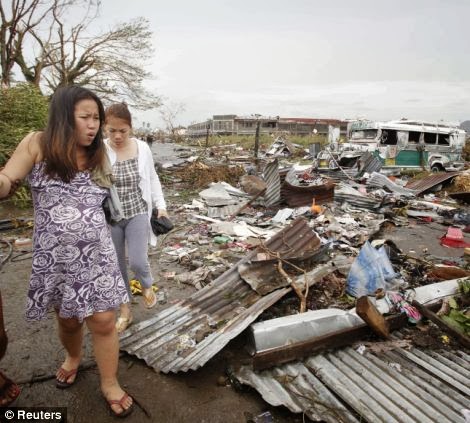
When the Philippine Coast Guard began recovery operations in Tacloban, together with all the other entities participating in search, rescue and recovery, they were appalled at the huge number of dead bodies floating in the sea off Tacloban's coasts and on the streets.

The National Disaster Risk Reduction Council (NDRRMC) began with a body count of the deceased at below ten. By the morning of November 11, 2013, NDRRMC declared that the number of casualties was 255.

Around the evening Malacanang told media in a press conference that the figure has gone up to 1,700. By reckoning, the final figure cannot be less than 10,000. Spokesman Mr. Edwin Lacierda refuted the claim of 10,000 casualties...

Yahoo and other quarter's estimate that there are 10,000 that are feared to be dead is correct. More > >
Photo credit: Agence France Press; Reuters; Manila Bulletin